Strengthen judgement
Help leaders distinguish between information, assumption and insight before making consequential decisions.
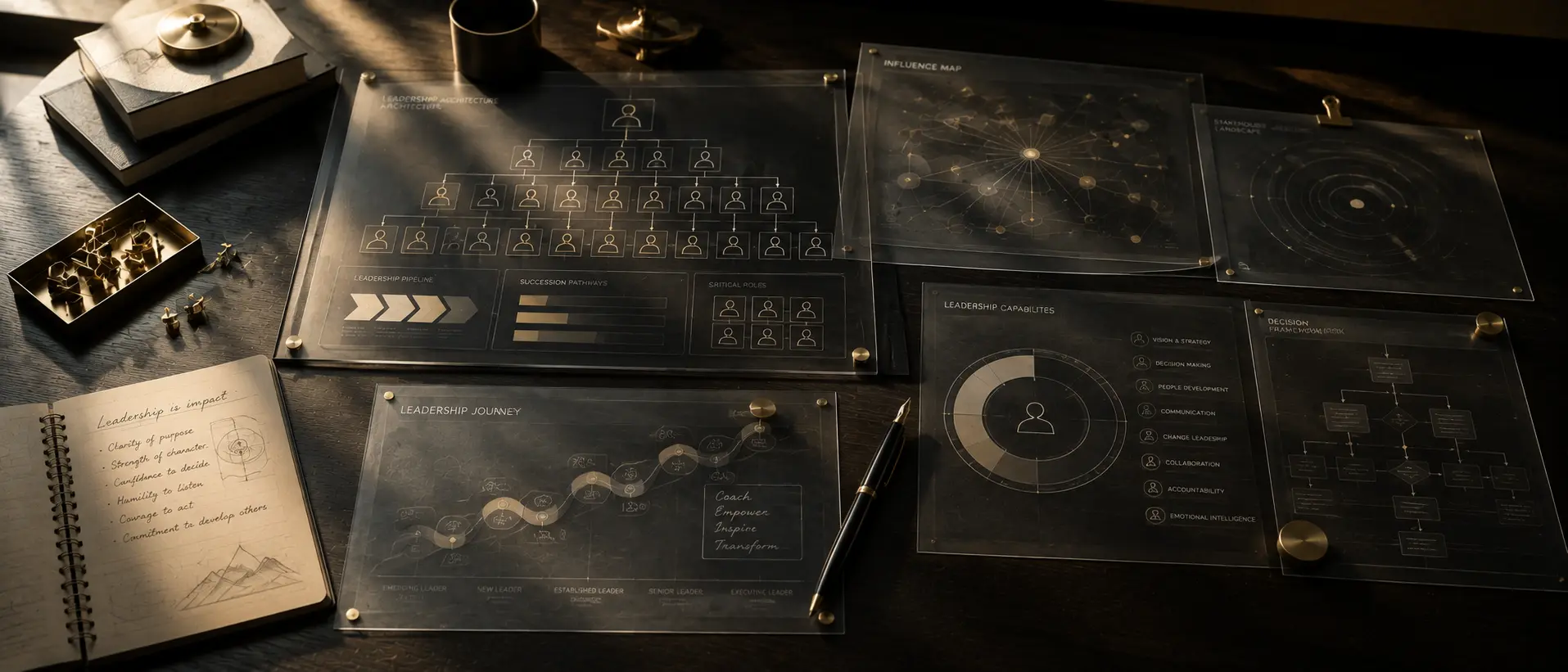
Organisations rarely struggle because they have no leaders. They struggle when leadership does not travel far enough through the organisation.
A leadership team can be intelligent, experienced and deeply committed to the organisation. Yet the quality of leadership experienced by the rest of the organisation can still vary dramatically.
Decisions become concentrated at the top. Managers wait for direction. Difficult conversations are postponed. Accountability becomes inconsistent. Teams learn to escalate rather than decide.
The organisation may still perform. But it becomes increasingly dependent on a small number of people to keep performance moving.
What happens when leadership becomes dependent on the leader?
That is not leadership at scale. It is organisational dependency.
Every leader shapes more than performance. They shape what people believe is acceptable, possible and expected.
Every decision a leader makes teaches the organisation how decisions should be made.
What leaders tolerate becomes culture. What they reward becomes behaviour. What they question becomes attention. What they repeatedly demonstrate becomes the organisation's unwritten standard.
EXECUTIVE LENS
Leadership development is not about creating more impressive leaders. It is about creating stronger organisations.
THE PRACTICE
Leadership capability is not built through inspiration alone. It is built through deliberate practice, reflection and increasingly difficult decisions.
THE LEADERSHIP ROOM
Help leaders distinguish between information, assumption and insight before making consequential decisions.
Develop the confidence to address performance, conflict and uncomfortable truths before they become organisational problems.
Create leaders who deliberately develop judgement, confidence and accountability in the people around them.
THREE CONVERSATIONS
What decisions are we still keeping at the top of the organisation that should already exist elsewhere?
What behaviours are our leaders reinforcing through what they reward, tolerate and ignore?
If our strongest leaders left tomorrow, what capability would leave with them?
THE SGCS DIFFERENCE
Workshops can introduce ideas. Real development happens when those ideas begin changing behaviour in the organisation.
TRADITIONAL LEADERSHIP DEVELOPMENT
SGCS PERSPECTIVE
Leadership is not what happens when the leader is present.
It is what continues to happen when the leader steps away.REFLECTION
LEADERSHIP AUDIT
Five questions worth asking before the next leadership programme.
THE PAPER
A deeper exploration of leadership, judgement, accountability, organisational behaviour and the capability required to lead through uncertainty.
Read the SGCS PaperTHE NEXT CONVERSATION
Strong organisations do not simply develop better leaders. They develop the conditions in which leadership can exist throughout the organisation.
Begin the conversation